|
Horse Pens 40 History
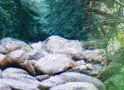
Horse Pens 40 has a very rich human history that dates back to the earliest occupation of this
area, with up to 15,000 years of human habitation and approximately 8,000 years of nearly constant use. The first humans to
see the mountain would have considered it a huge fortress that could provide them protection, shelter, food, and water, throughout
the year. There are numerous springs and streams all throughout the park. Many of the people who first came to this area lived
under the overhangs along the streams at certain times of the year. They considered the ancient naturally carved rock formations
to be unique and very special, the perfect place for their ceremonies and sacred rituals. Many times during the year they
would climb the mountain to hold their ceremonies in the huge natural amphitheater or in the area next to the Big Horse Pen,
known today as "the stone fort". Inside the stone fort is the Thunderbird rock, which was very sacred to some of the early
Indian tribes, and is believed by some to be the origin of the chipped stone bird fetishes found throughout the Southeastern
US.
Our Native American gahterings continue an 8,000 to 10,000 year old tradition of ceremonial
gatherings, ceremonies, and festivals here. Since it is a natural stone fortress atop a fortress-like mountain, it was
used by the Native Americans as a protected village and ceremonial area for thousands of years. There are living and working
areas as well as burial areas dating back to the Paleo (pre- Stone Age-12,000+ years ago) and Archaic (early Stone Age-10,000
years ago) periods up to more recent times throughout the park. We also have what may be the only remaining example in the
United States of an ancient leaching pit that has seen actual historical use. It was used to remove the tannic acid from acorns
and hickory nuts in order to render them edible for making meal for bread. This is an ancient high-volume food processing
area that could produce about 150 lbs. of edible meal every day or so. Normally they were temporary structures dug in clay,
but ours is in a natural stone cavity and could still be used today.
(NOTE: While we encourage the use of the park for recreational, historical, nature study, and
educational purposes, all areas of the park are strictly protected under Federal law as well as closely guarded by our family
against looting, vandalism, and destruction. We allow no digging, artifact hunting or removal, or any disturbing of the ground,
rocks, plants, or animals at any time. We have several rare and endangered species of plants, animals, and birds, as well
as many unique rock formations throughout the park and all are strictly and strongly guarded and protected at all times.)
In more recent times, it was constantly used and fought over by the Creek and Cherokee tribes
and the only peace treaty ever made between the Creeks and the Cherokees was signed on this property. Some of the cleared
fields in the park are known as "Cherokee old fields" due to their having been cleared and used for growing crops by the Native
Americans. During the Cherokee removal (known as the Trail of Tears) many Cherokee left their homes and came here to hide
from the military and civilian forces that were hunting and pursuing them. Some later settled in the rough and remote hill
country nearby, eventually marrying into the local families, and even today many of their descendants still live in the nearby
hills.
Later during the War of Northern Aggression, it was used by the locals to hide their horses, children,
and valuables from both the Northern troops as well as the Confederates. After the Confederates discovered it, it was reportedly
used as a supply depot, staging area, and Home Guard outpost. (The Home Guard was mostly comprised of local young boys, older
men, and others generally deemed physically unfit for service in the regular Confederate Army). Supplies stored in the Confederate
Canyon area of the park were said to have been used by Gen. Nathan Bedford Forrest and his troops in their pursuit of
the Yankee raiders under Gen. Abel Straight. (The 16-year-old heroine, Emma Sansom, aided Gen. Forrest in the hotly contested
crossing of nearby Black Creek, enabling him to continue his pursuit.) Gen. Forrest, with only 420 poorly mounted and ill-equipped
men, doggedly pursued and finally surrounded the 1,640 Union raiders under Gen. Straight, forcing the Union general to
surrender himself and his entire command not far from here. This saved the city of Rome, Georgia (with its arsenals and stores
of important war supplies) from destruction.
A small skirmish also occurred near here between the Home Guard and a large local gang of notorious
"bushwhackers" and outlaws known as The Springfield Gang. The gang, numbering up to 60 or more at times, attempted
to steal an entire wagon train loaded with supplies and ammunition that had been stored here at Horse Pens. Capt. Joshua Smith
and the men of the Home Guard drove off the outlaw gang, delivered the wagon train intact, and are said to have killed
13 of the bushwhackers while losing none of their own men. There could have been no more than 40 or so men available to the
Home Guard, and probably their numbers were much less. That's pretty good fighting.
Later years brought the moonshiners and the outlaws who used the remoteness of the area to conceal their
activities. There are two known outlaw hideouts in the park, while many of the rock shelters would have provided perfect hiding
places for anyone who did not wish to be found. One of the hideouts, said to have been used by the famous Alabama Outlaw Rube Burrow whenever he was in the area, contains a stable area connected by hidden passages to a room with a viewing
port and a stone door escape route.
A young couple named John and Hattie Hyatt finally settled on this land during the late 1800's.
The story is that he came from Georgia with his 'stolen wife' (whatever that meant), a horse, and all his earthly possessions
in a flour sack. Looking for a place of refuge, the Horse Pens was a natural choice. Years later, he filed on the property,
referring to it as "the home 40, the farming 40, and the horse pens 40, each tract containing 40 acres of land". This is how
Horse Pens 40 got its name. This is one of the last homesteads filed in the state of Alabama. The land patent and original
title was actually signed by the President of the United States. (Actually, the signatures of two U.S. presidents turned up
on documents pertaining to the property during the title search)
In the 1950's, a newspaper reporter named Warren Musgrove came to do a story on the tomato farming
on the mountain, and was told of the magnificent wonder of nature located nearby. While exploring the ancient stone fortress,
he noticed the natural amphitheater in the rocks, and got the idea to put on bluegrass festivals, country food fairs, and
craft shows here. This was one of the first outdoor bluegrass music festivals in the United States, and by the 1970s it had
become known as one of the largest bluegrass festivals in the world. Later, the park was recognized by the Alabama State Legislature
in House/Senate Joint Resolution 177 (HJR177) as "The Home of the Souths Bluegrass Music". Many famous musicians got their
start here, including EmmyLou Harris (who made one of her first public appearance here at 16 years old), Three On A String,
Marty Stewart (at 17 years old), and more. Almost every famous bluegrass music personality has made an appearance here, including
Bill Monroe, Dr. Ralph Stanley, Doc Watson, Deacon Dan Crary, Ace Weems and the Fat Meat Boys, The Osbourne Brothers, Sam
McGee, The Red Clay Ramblers, Norman Blake, Lester Flatt, Earl Scruggs, Charlie Daniels, Ricky Skaggs, Allison Krause, and
many more. The festivals grew so large that tickets were available by invitation only. The crowds sometimes exceeded
10,000 people over the course of the festivals, and there were very few of the modern facilities that we have here today.
Nowadays we are much better equipped to handle the smaller crowds that we allow, and we intend to limit the numbers
as necessary to protect the natural areas of the park.
The Schultz Family
and the Staff of
Horse Pens 40
Legal notice: HP40 management and staff reserves the right, solely at their discretion, to refuse,
curtail, revoke, or deny any admission, discount, or service to anyone at any time, for any reason, with no reason required
to be stated. According to the situation causing the action to occur, and the attitude of the parties involved, a refund may
be denied or not offered. All admission fees, user fees, camping fees, discounts, group rates, or any other rates or services
are offered or accepted solely at the discretion of HP40 management and staff, and may be changed, ended, revoked or denied
at any time, with no reason required to be stated, with or without a refund given.
Alabama Outlaw Rube Burrow

|